
A Crab Walks into a Cathedral…
The Big Idea: An ideator's role isn't to solicit ideas, it's to help them grow.
I'm lucky to live in Chicago, one of the great improv cities. We have Improv Olympic. We have Annoyance. But I feel most at home playing at Second City.
You hear a lot about "yes, and." What people don’t know is that yes-and exists to build a shared reality. If one player thinks the scene is on a pirate ship and the other thinks it's in a courtroom, the audience is confused. Confused people don't laugh. (although, I would like to play a mashup version of this scene).
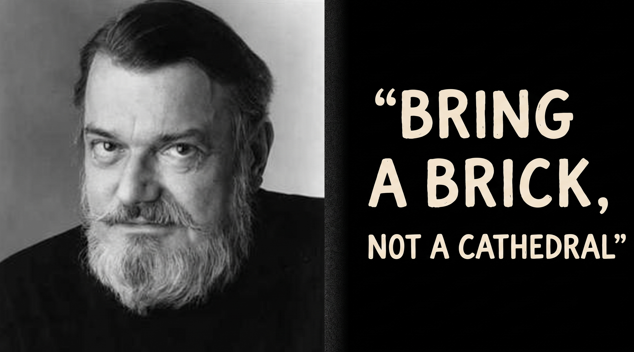
Del Close’s famous quote about improv reminds us not to come with a map of how the story will play out. We build it together, brick-by-brick.
Ideation sessions are improv. Creating a shared reality is the whole game.
Last post, I made the case for building physical connection before the session starts using the concepts of Gravity and Triangles. Today, we move into social connection, shared worlds, and the idea crabwalk.
Connection before content.
This is a favorite quote of Chad Littlefield’s, whose We Connect Cards I use in every session. We walk in as strangers and have to become a team fast, so the first move is a low-stakes share.
At the event start, let everyone grab a drink, ease into the room as traffic flows in, and simply ask them to grab a card that speaks to them and use it as a coaster.
Once we’re ready to start, we go around the room for a brief intro: name, role, card you’ve chosen. Some just read what's on it, some simply show the picture on the back. Others explain why they picked it. All forms of sharing are welcome.
The point isn't the content of the card, it’s connecting to the room. Everyone has now spoken. And no one was injured in the process. The ice is broken, so the hurdle to the second thing they say is much lower than the first thing.
Context before collaboration.
Sub-Idea: With different realities, the room deliberates. With a shared reality, the room collaborates.
We have started to connect. The room is becoming a social group. But are we a pirate ship or a courtroom?
This is the part in improv where the audience calls out the scene and the characters.
You’re a pirate, I’m a suburban dad who found your pirate ship for sale on Facebook Marketplace, and I’m here to inspect it before I buy. Start scene…
In ideation sessions, before we collaborate, we have to set the context - consumer insights, trend work, design guardrails (hopefully only a few). Since everyone is taking in the same material, we start to land on a shared reality.
This gives the group the same contextual starting point. Why are we here? Who is our customer? What does the future look like if we are successful today? Now we have a shared place to diverge from.
Ideas are like hermit crabs - they keep outgrowing their shells.
By now, we have created connection and shared context - next we crabwalk. At Dovetail, many of our ideation sessions involve tasting tours/culinary crawls. This is where we start to form ideas.
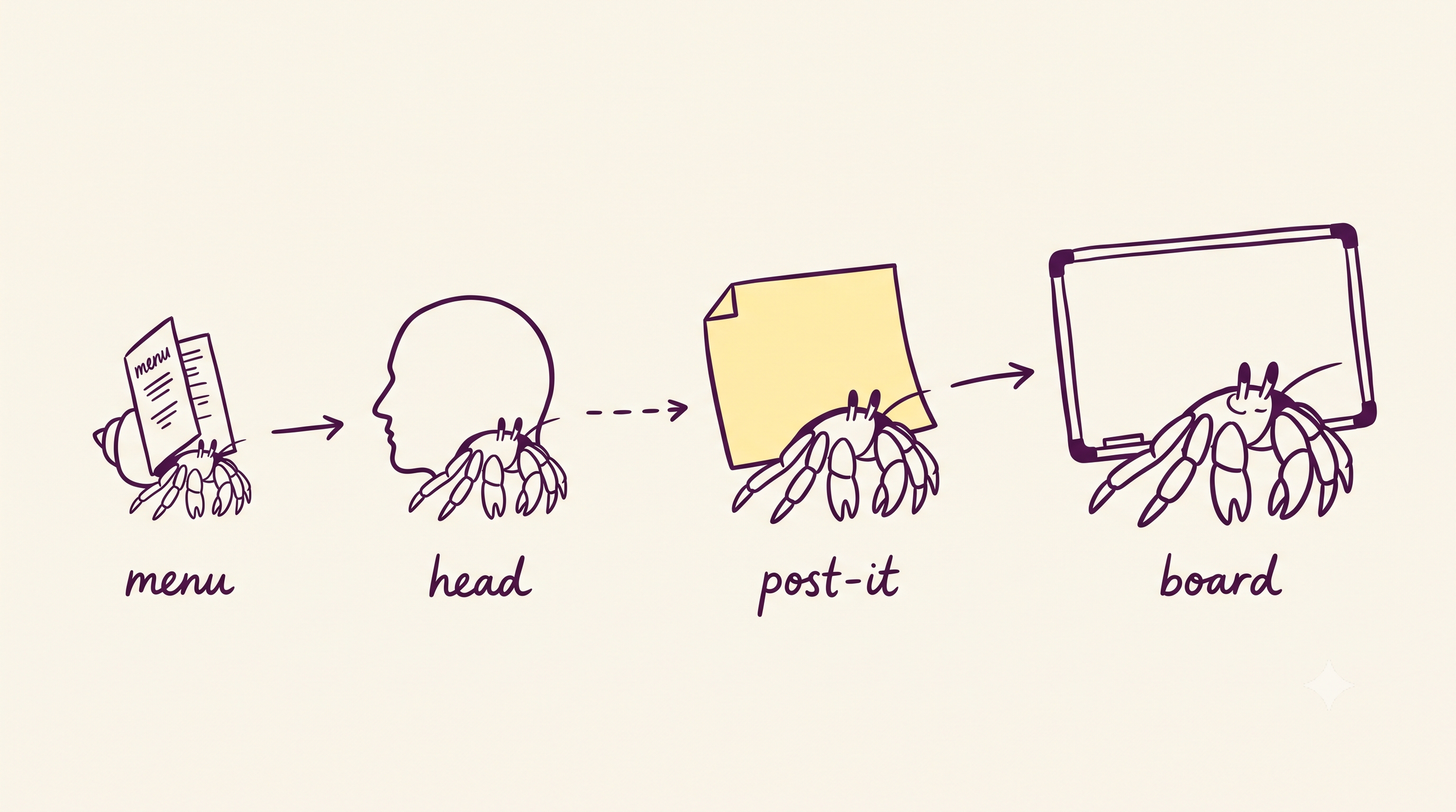
I like to think of ideas as traveling in containers. In our sessions, we like to ideate in the in-between. The moments where the container changes - and with each change, the ideas grow.
Think of the humble hermit crab. As it grows throughout its lifetime, it must find a bigger and bigger shell.
In these sessions, the path runs like this: dish/menu → head → post-it → board
Someone tastes a breakfast sandwich. Their head does something with it: “that avocado was unreal, this would also be great with a fried egg”. Boom, you have two ideas. They write it on a post-it note and jot down the word “chili crisp” in the margins. Now there are four ideas. One was a steal, one was a swap, and two were adds.
They get into the room and shout it out for a facilitator to write on a white board. A well-oiled group - one with connection and context - starts building on it. What would make this more healthy? More indulgent? More suited for the lunch menu at Potbelly?
The shell gets bigger and the crab brings friends. One idea becomes ten. And somewhere along the journey, you drop your filter. You’re playing, you’re actively listening, you’re just having fun. You’re laying bricks. That’s improv.
Good ideas molt.
An ideator's job isn't simply to solicit ideas. It's to help them grow.
That’s the crux of it. Create a shared reality, bring a brick, and together you can crab walk into a cathedral.